Stories upon stories
From a story told around a fire to the ideas that shape everyday life.
How did humanity get here — and which inherited assumptions still shape life today?
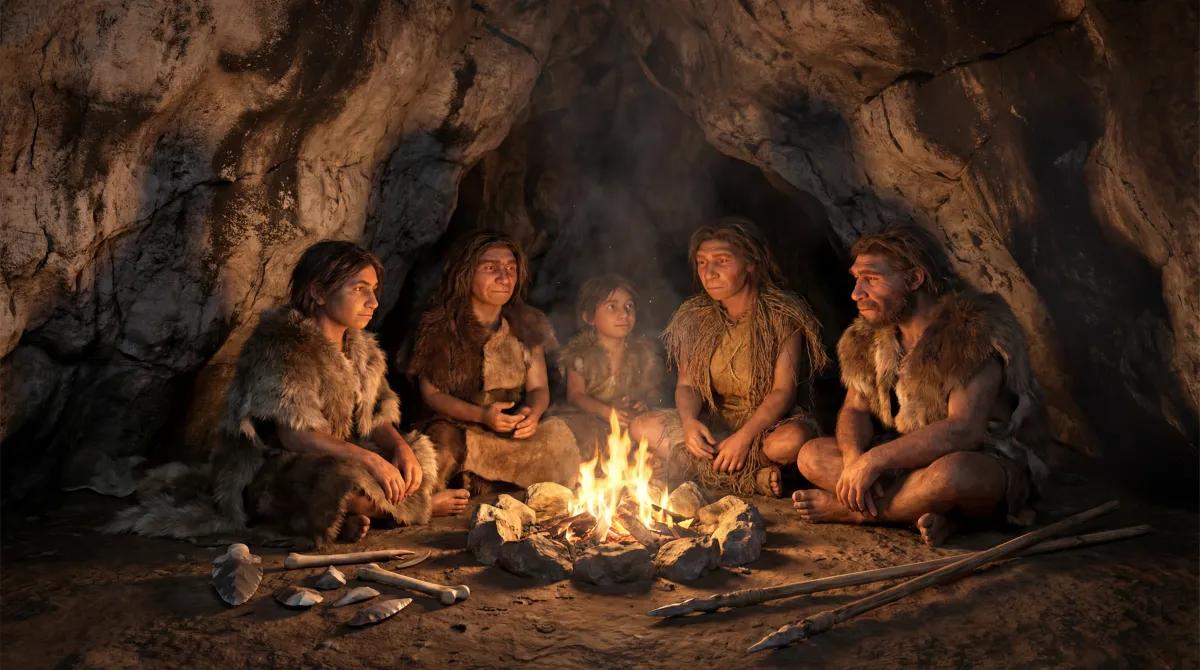
Each listener brings a different world
Imagine people gathered around a fire. One tells a story about meeting a lion: the danger, the fear, the decision that made survival possible.
The listeners hear the same words. But each brings a different life to them. Experience, skills, confidence, fear, trust in the storyteller and the state of that particular evening all become part of the picture.
One imagines fighting. Another imagines hiding. Someone else remembers a danger the storyteller has not experienced.
The story arrives through the listener's own understanding of what is possible.
That understanding helps people make sense of incomplete information. It also means that an event, its telling and its meaning to another person are different things.
An interpretation can become a belief. A belief can shape the next decision. That decision creates another experience — and another story.
The story travels, and changes
Later, a listener passes the story on. The next person receives what was remembered, understood and considered important.
Details can disappear. Motives can be added. An explanation can become more certain as it travels, even when nobody has returned to the original event.
In this imagined example, surviving a dangerous encounter might become a lesson about courage. That lesson might become a rule that retreat is shameful. A conclusion from one situation begins directing people in very different situations.
A story becomes a story upon a story.
Discussion, evidence and other people's experience can also improve that picture. The important distinction is whether an account has been checked, interpreted or simply repeated.
Eventually, people are born inside the stories
Shared interpretations can become customs, expectations and rules. Rules shape institutions. Institutions shape the opportunities, pressures and choices available to the next generation.
A person enters a world already organised around ideas about work, success, education, family and a respectable life. Much of that world feels natural because it was there before the person could question it.
The original reasons for a rule may have faded. Its consequences remain in schools, workplaces, routines and everyday decisions.
People inherit both accumulated knowledge and accumulated assumptions.
Much of that inheritance makes cooperation possible. Some of it needs revisiting as circumstances change. A useful answer from an earlier world may no longer answer the question people face today.
Why changing one assumption can become so difficult
An established rule rarely stands alone. Other decisions, commitments and ways of earning a living may depend on it. Changing it requires understanding what else would change with it.
A society might treat constant busyness as evidence of success. Organisations reward it. People adapt to those rewards. Their busy lives then seem to confirm that busyness must be necessary.
This is a possible self-reinforcing loop: the consequences of an assumption become the evidence used to preserve it.
The question is how to preserve what still helps people while making room to reconsider what no longer does.
An AI answer can become part of a person's life
The same pattern is easy to imagine in a conversation with AI. Language models can produce confident, plausible statements that are incorrect. That limitation is described in the research paper Why Language Models Hallucinate.
Imagine a person asking how to learn a new skill while keeping their job. The answer suggests a programme, describes it as flexible and assumes its qualification will be recognised in the field the person hopes to enter.
The person asks for a plan. The next answer builds a timetable around that programme. A later answer explains how to fit it around work and family.
Each step can look sensible. Each step also inherits the assumptions of the first answer.
The person makes room in the week, discusses the plan with family, postpones another opportunity and begins arranging a different future. The programme's format and recognition still have not been checked.
When one of those assumptions turns out to be wrong, correcting a sentence is no longer enough. Other choices have already been made around it.
The error has moved from an answer into the structure of a life.
Most of the answer might have been useful. The problem can be one detail that quietly became the foundation of subsequent choices. Asking the same model to elaborate may produce a more complete plan without supplying independent confirmation of that detail.
The question is therefore larger than whether a single answer is correct. It is whether the path makes room to check its foundations, expose uncertainty and revisit the decisions that depend on them.
The campfire story and the AI example share a pattern: interpretation → belief → decision → consequence → another interpretation. They are thought experiments about how that pattern can unfold.
Faster toward what?
A tool can make a task easier without making a life easier. The difference lies in what happens to the benefit.
Suppose a task takes five hours. A new tool reduces it to one. Four hours could become time for rest, relationships, curiosity or another chosen project. They could also become four more tasks.
The same improvement serves two different purposes.
More capability creates a choice about what progress is for.
Capability asks what can be done. Efficiency asks how quickly. Results ask whether a target was reached. Value asks whether that target matters. Direction asks what kind of life the whole process is building.
This proposal begins with those last two questions. More capable technology should be judged by what it makes possible in people's lives: more time, more freedom, less unnecessary pressure and more room for very different ways of living.
A system that can reconsider its own direction
The proposed architecture brings the reasons for decisions and their human consequences into the same picture. It needs seven connected capabilities:
- Purpose: understand what people actually want from life.
- Understanding: distinguish experience, interpretation and assumptions.
- Evidence: keep important claims, uncertainty and disagreements visible.
- Connections: see what depends on a decision and who an adjustment would affect.
- Cooperation: turn shared directions into practical proposals and projects.
- Results: learn what changed in people's lives.
- Correction: revise the path — including the original goal — when experience calls for it.
The purpose is to keep a path connected to the people it is meant to serve. Existing knowledge and institutions remain part of that picture; their usefulness can be examined alongside new possibilities.
The result has to return to the human being
Production, speed and the number of completed tasks tell part of the story. A human result requires other questions too.
Is there more time for a life freely chosen? Is it easier to find understanding and people with whom life feels good? Are basic needs more secure? Is there more room to learn, create, explore and help others?
Health, safety, autonomy, relationships, access to knowledge and the condition of the shared planet also belong in that picture. Benefits and costs can be distributed very differently among people.
These outcomes sometimes conflict. Greater convenience may ask for more data. One person's opportunity may create pressure for someone else. A useful process must make those differences visible.
A person's satisfaction matters. So do the consequences experienced by other people.
A single measure would lose much of that meaning. The aim is a clearer picture that people can understand, question and improve together.
Who gets to decide what a better world means?
The people designing a new system bring their own assumptions too. Their model has to remain open to correction by the people living with its consequences.
That requires understandable reasons, evidence that can be challenged, room for different perspectives and changes that can be limited or reversed when they fail.
A shared direction must preserve personal choice and the rights of those who disagree. Majority support cannot make a person's life, identity or interests disappear.
Different ideas of a good life belong inside the question.
AI can help assemble experiences, reveal contradictions and explore possible paths. People retain the choice of what to pursue, what to question and what to refuse.
Two cycles have to work together
One cycle carries experience forward: people understand, share, build and pass on what they learn. It gives life continuity and makes cooperation possible.
The other asks whether the inherited picture still fits: what changed, what was missed and whether the result still serves the original purpose.
A living system needs both continuity and the ability to reconsider.
Useful experience can be preserved while an outdated assumption is changed. The next generation should inherit ways to question the path as well as ways to follow it.
A practical check before the next step
The same questions can be asked about education, work, a shared project or a personal decision:
- What is the desired result, and why does it matter?
- What is happening now?
- Which assumptions connect the current path to the desired result?
- What evidence supports them, and what challenges them?
- Who and what would be affected by a change?
- What small, reversible step could test a better path?
This makes a broad ambition testable in everyday life. A proposal can meet real experience, be changed by it and move forward with a clearer reason.
From people's experience to practical change
This is the wider ambition behind Life GPS and its human side: a flexible process that stays connected to what people want and what they actually experience.
The current step is to connect people through Pulse. The stages below describe how that wider process could develop.
1. Now: connect through Pulse.
People join Life GPS, set up their profile and register their Pulse. The Pulse registration window appears after profile setup. Each brings a different life, experience and perspective.
2. Describe the life people want.
As the shared process develops, people can express what matters to them, what is missing and what kind of future they would like to help create.
3. Find shared directions.
AI can help reveal where those wishes meet, where they differ and which questions need more understanding. Common ground can become a direction while differences remain visible.
4. Understand what stands in the way.
Each direction leads back to its purpose and the causes of the present gap. People with relevant experience help examine what would actually need to change.
5. Build and try the next step.
Shared proposals become practical experiments. People improve them, adapt them to their circumstances and choose which projects to pursue together.
6. Ask whether life became better.
The result returns to the people affected: what helped, what failed, whose needs were missed and whether the original goal still matters.
7. Adjust as people and the world change.
New experience changes the picture. Wishes evolve. The path can be corrected, a proposal replaced or a direction reconsidered.
A direction can be revised as people's needs, circumstances and experience change.
The experiment starts with the people who choose to join it.
Start with Life GPS on iPhone through TestFlight. Set up the profile, then register Pulse. Return to Pulse for the human-side manifesto.
Concept by Alexandru Goroh. The opening scene and AI decision chain are imagined examples. The wider collective process is a proposal; the cited research supports the statement about language-model errors, not the effectiveness of this proposed system.